
Profession Regulator & Association Solutions
Professional regulatory bodies and membership organizations today operate in an increasingly demanding and evolving environment. Rising member expectations, complex compliance obligations, and rapid digital transformation are pushing organizations to rethink how they function. In such a landscape, relying on traditional systems is no longer sufficient. This is where Professional Regulatory Solutions and advanced Regulatory Compliance Services play a critical role in helping organizations stay efficient and future-ready.
To remain transparent, responsive, and compliant, organizations must adopt modern Association Management Solutions tailored specifically for regulatory authorities and professional bodies. These platforms are no longer optional—they are essential tools that support governance, licensing, and member engagement while ensuring seamless Compliance Management for Associations.
Understanding and adopting the right Professional Association Consulting approach can significantly improve operational efficiency, enhance public trust, and streamline regulatory workflows. With the support of expert-led Regulatory Advisory Services, organizations can better navigate evolving compliance landscapes and build stronger systems.
What Are Profession Regulator & Association Solutions?
Profession regulator and association solutions—commonly referred to as Association Management Systems (AMS)—are comprehensive Regulatory Consulting Services platforms designed to manage the core operations of licensing authorities and membership organizations.
These systems go beyond basic tools by offering integrated Industry Association Support Services that align with strict regulatory and public-interest responsibilities. Unlike generic CRM or ERP systems, these platforms are built specifically to support Regulatory Framework Consulting and ensure organizations meet statutory and governance requirements.
They provide end-to-end Compliance Solutions for Professional Bodies, helping regulators manage licensing, maintain transparency, and ensure professionals meet defined standards. Whether the organization governs engineers, healthcare professionals, legal practitioners, or financial advisors, these systems provide consistent and reliable operational support.
Additionally, these platforms simplify Regulatory Filing and Documentation Services, ensuring all compliance records are accurate, up-to-date, and easily accessible for audits and reviews.
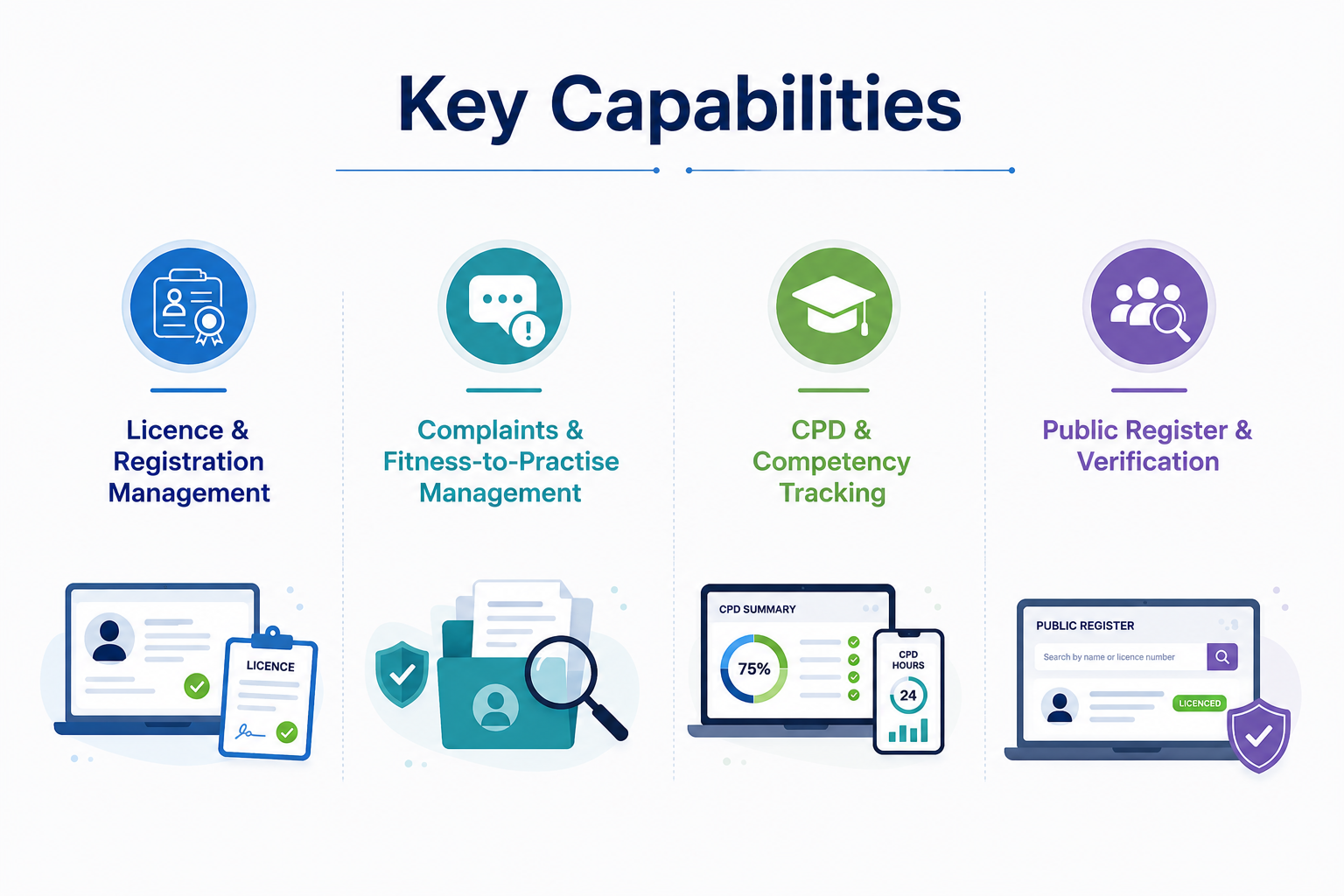
Key Capabilities
Licence & Registration Management: Supports the complete lifecycle of licensing—from application to renewal—while offering efficient Licensing & Registration Support for Associations. These systems automate verification processes and ensure accurate record-keeping aligned with Professional Body Compliance Services.
Complaints & Fitness-to-Practise Management: Provides structured case management tools to track complaints, investigations, and hearings. This ensures transparency and aligns with regulatory standards, strengthening Association Governance Services.
CPD & Competency Tracking: Helps professionals track continuing education and ensures compliance with competency frameworks. These tools are essential for maintaining industry standards and delivering effective Compliance Solutions for Professional Bodies.
Public Register & Verification: Maintains a transparent, real-time database of licensed professionals, improving public trust and enabling easy verification while supporting Regulatory Compliance Services.
Why Regulators Are Modernising Now
Professional regulators and membership organizations are increasingly investing in modern digital systems to keep up with growing operational demands and public expectations. With the support of Professional Regulatory Solutions, organizations are transforming how they manage compliance, licensing, and member engagement in a more efficient and scalable way.
Traditional processes built around spreadsheets, paper records, and disconnected systems are no longer able to support the speed, transparency, and accountability required today. This is why many organizations are also turning to expert-led Regulatory Consulting Services to guide their digital transformation and ensure the right systems are implemented effectively.
Recent industry insights highlight why this shift is happening so quickly:
|
73% cite outdated systems as top operational risk |
4.2× faster complaint resolution with case management |
60% reduction in manual data entry post-AMS |
92% member satisfaction with self-service portals |
Several factors are rapidly accelerating the adoption of regulatory management software. Today, the public expects greater transparency and clear, auditable accountability from regulatory bodies. At the same time, the rise of remote work and cross-border operations has made traditional paper-based registers outdated and inefficient. Additionally, many regulators are facing resource constraints and need smarter, automated systems that allow their existing teams to work more efficiently and manage compliance at scale.
Core Features to Look for in Any Regulatory Management Solution
When evaluating professional body management platforms, it’s important to look beyond basic membership databases. A true regulatory technology platform offers deeper capabilities designed specifically for regulatory operations. The difference becomes clear when you assess how well the system supports five key areas:
Intelligent Licence Lifecycle Management
A robust licence management system should support the entire registration journey from start to finish. This includes the initial application, identity verification, qualification checks, annual renewals, late renewal processes, voluntary removals, and licence restoration. The system should allow configurable business rules and ensure that data flows seamlessly between each stage without the need for manual re-entry.
Statutory Complaints & Fitness to Practise
Handling complaints in a regulatory environment is far more complex than standard customer support ticketing. A capable platform should provide structured complaint intake, proper triaging, and legally sound case management. It should also support panel and hearing scheduling, decision recording, sanctions management, and appeal processes. Most importantly, every action should be fully logged to maintain a clear audit trail that can stand up to legal or judicial scrutiny.
Configurable Public Register
The public register is one of the most important trust points between a regulator and the public. A good solution should allow real-time updates to licence status, maintain historical records, and provide tools such as employer verification APIs. It should also ensure that any public-facing data complies with privacy and data protection standards.
CPD Framework Management
Continuing Professional Development (CPD) requirements vary across professions. Whether the framework is based on learning hours, outcomes, or professional portfolios, the platform should be flexible enough to reflect your specific model. The software should adapt to your CPD framework—not force your organisation to change its processes.
Governance & Council Management
Effective governance is essential for regulatory bodies. Features supporting board and council operations—such as elections, conflict of interest declarations, committee management, meeting documentation, and policy records—should be integrated within the platform. Keeping these processes in one system avoids the inefficiencies and risks associated with scattered email chains and shared drives.
How to Evaluate Vendors: A Decision Checklist
When shortlisting professional association technology vendors, run every candidate through this structured evaluation:
✓ | Does the platform support your specific regulatory framework (statutory, chartered, voluntary)? |
✓ | Is the public register API-accessible for third-party verification partners? |
✓ | Can fitness to practise workflows be mapped to your existing statutory process without customisation overhead? |
✓ | Does the vendor hold relevant certifications (ISO 27001, Cyber Essentials Plus)? |
✓ | Is data sovereignty guaranteed — where exactly is member data hosted? |
✓ | What is the vendor’s track record with organisations of comparable size and complexity? |
✓ | What does the implementation timeline and change management support look like? |
✓ | Is there a configurable sandbox for testing regulatory rule changes before live deployment? |
Implementation & Change Management
Even the most powerful regulator management platform may fail to deliver its full value if the implementation process is not handled carefully. Technology alone is not enough—successful adoption depends on how well the change is managed within the organization.
Organizations that achieve smooth deployments usually share three key practices. First, they have strong executive sponsorship that keeps the project moving forward, even when challenges or resistance arise. Second, they adopt a phased rollout approach, launching the most impactful modules first instead of trying to implement everything at once. Third, they invest early in staff training and clear communication with members so everyone understands the new system and its benefits.
Another important factor is treating technology implementation and change management as two parallel priorities rather than separate tasks. When organizations manage both together, they typically experience fewer disruptions, smoother system launches, and faster returns on their investment.
It is also essential to build a cross-functional implementation team from the beginning. This team should include representatives from operations, IT, communications, and legal departments to ensure that every aspect of the organization is considered during the rollout. At the same time, your software vendor should provide a dedicated implementation lead who understands the regulatory sector and can guide the process effectively.
After the system goes live, the work doesn’t stop. Establishing quarterly business reviews with your vendor helps track system performance against key performance indicators (KPIs) and identify opportunities for improvement. The best regulator software vendors treat these reviews not as routine formalities, but as opportunities to strengthen the partnership and ensure the platform continues to deliver long-term value.
Conclusion
In an increasingly complex and digitally driven environment, professional regulators and membership associations can no longer rely on outdated systems and manual processes. Modern Profession Regulator & Association Solutions provide the technological foundation needed to manage licensing, compliance, governance, and member engagement in a more efficient and transparent way. By integrating essential functions such as licence lifecycle management, complaints handling, CPD tracking, and public registers into a single platform, these systems help organizations operate with greater accuracy, accountability, and speed.
As regulatory expectations grow and stakeholders demand higher levels of transparency, adopting purpose-built digital solutions is becoming a strategic necessity rather than a technological upgrade. However, the real value of these platforms lies not only in their features but also in how carefully they are selected and implemented. Organizations that evaluate vendors thoroughly, align the system with their regulatory frameworks, and invest in strong change management are far more likely to achieve successful outcomes.
Ultimately, the right regulatory management platform empowers professional bodies to strengthen governance, improve operational efficiency, and deliver better services to both members and the public. By embracing modern technology and thoughtful implementation strategies, regulators and associations can build more resilient, future-ready organizations that maintain trust, uphold professional standards, and confidently meet the evolving demands of the professions they serve.

Bringing public and patient perspectives into regulation to strengthen trust and inform decision-making.
Supporting the refinement of standards, codes of ethics, and professional principles through research, engagement, and validation.
Designing KPI frameworks, dashboards, and evaluations that measure outcomes and guide continuous improvement.
Delivering confidential, high-caliber feedback for physicians and healthcare teams to improve professionalism, communication, teamwork, and quality of care.
Engaging professionals to improve licensure pathways, enhance engagement, and support regulatory reform.
 Voice of the Public (VoP) Programs
Bringing public and patient perspectives into regulation to strengthen trust and inform decision-making.
 Performance & Evaluation
Designing KPI frameworks, dashboards, and evaluations that measure outcomes and guide continuous improvement.
 Standards of Practice Reform
Supporting the refinement of standards, codes of ethics, and professional principles through research, engagement, and validation.
 360° Feedback Assessments (PULSE)
Delivering confidential, high-caliber feedback for physicians and healthcare teams to improve professionalism, communication, teamwork, and quality of care.
 Registrant Experience Solutions
Engaging professionals to improve licensure pathways, enhance engagement, and support regulatory reform.
